
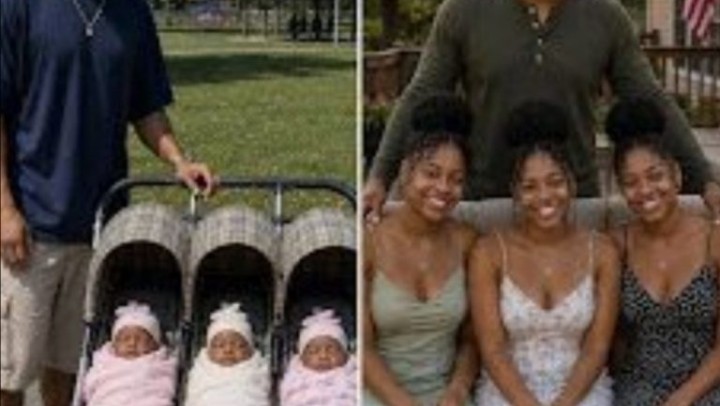
ADOPTED MY THREE BABY SISTERS AFTER OUR MOTHER ABANDONED US — 20 years later, they handed me a letter from her I was never meant to see.
I was twenty-three when my whole life changed in the space of a single afternoon.
I’d just finished college that spring, and a job offer in Chicago was waiting for me — the kind of offer I’d spent four years working toward, the kind you don’t turn down without a very good reason.
I came home early that day specifically to tell my mother I’d gotten it.
Instead, I heard her screaming before I even made it through the front door.
⸻
She was stuffing clothes into a suitcase when I found her, moving fast, sloppy, nothing folded the way she usually insisted on folding things. Down the hall, my three baby sisters — three months old, all three of them born the same spring — were crying in their cribs, the kind of crying that had clearly been going on for a while.
“Mom,” I said. “What are you doing?”
She kept packing.
“I can’t do this anymore, Micah.”
She looked up at me then, and something in her face had already gone somewhere I couldn’t reach.
“I already spent my whole life raising one child,” she said. “I’m not starting over with three more. I want to live while I still can.”
⸻
I followed her downstairs, my heart going faster than I could keep up with, begging her to slow down, to sit for one minute, to give me even a single day before doing something we couldn’t undo.
She opened the front door anyway.
“Mom, please,” I said. “They need you.”
She lingered there for a moment, one hand on the frame, looking at me like there was something else she wanted to say. Whatever it was, she didn’t say it. She just walked out to her car and drove away without another word.
There was no aunt waiting somewhere to step in. No grandparent with room in her house. No distant relative who’d suddenly appear to save us the way people always assume someone will.
There was just me.
⸻
I called Chicago that same week and turned down the only job offer I’d ever truly wanted.
For a while, I told myself she’d come back. I checked the driveway every night for months longer than I probably should have. Eventually, though, I stopped waiting and started gathering the paperwork instead — the forms, the home visits, the long, exhausting process of legally becoming the guardian, and eventually the adoptive father, of three babies who were, biologically, my own sisters.
People had opinions about it. Most of them felt entitled to share those opinions directly to my face.
“Micah, you’re twenty-three,” a coworker told me once, not unkindly, just baffled. “You’re giving up your whole life.”
I never felt that way, not once, not even in the hardest years. Every time I looked at those three small faces, giving anything up never once crossed my mind as the right way to describe what I was doing.
⸻
I learned things in those first two years that no twenty-three-year-old expects to learn all at once. How to hold one crying baby while bottle-feeding another. How to sleep sitting upright in a hallway chair, angled so I could see all three cribs at once during the worst of the sick nights. How to stretch a single paycheck so thin it nearly tore, and somehow still keep three kids fed, clothed, and current on every doctor’s appointment.
I worked nights for years so I could handle daycare drop-offs and pickups myself. I stopped dating almost entirely, not out of bitterness, just because there wasn’t room left in a day that already ran from five in the morning until whenever the last of them finally fell asleep.
The first time all three of them called me “Dad” — Nora first, then Piper and Wren picking it up within the same week, the way toddlers do — I locked myself in the bathroom afterward and cried hard enough that I had to run the sink so they wouldn’t hear me through the door.
⸻
Life was never easy, not in any of the years that followed, but we had each other in a way I don’t think any of us ever took for granted.
We started a tradition early on — one photo, every year, on the anniversary of the day I filed the adoption paperwork, all four of us lined up against the same living room wall so we could watch, year after year, exactly how much we’d all changed.
Twenty of those photos hang in a hallway of my house now, in order, from three babies too small to sit up on their own beside a twenty-three-year-old who had no idea what he was doing, all the way to three twenty-year-old women standing beside a man well into his forties.
Our mother never once reached out in all that time. Some years, especially the busy ones, I genuinely forgot the girls were my sisters and not my daughters. It stopped mattering which word technically applied a long time before this past June.
⸻
This past June, on my birthday, all three of them came home the same evening, the way they always did.
Usually, that meant arguing loudly the second they walked through the door over whose bakery had made the better cake that year, a running joke that had somehow survived two decades without ever getting old.
This year, they barely spoke at all.
Nora didn’t say a word through the entire dinner I’d made. Piper’s eyes were swollen, red-rimmed in a way makeup hadn’t quite managed to cover. Wren wouldn’t look at me directly, not once, the whole meal.
“What happened?” I finally asked, setting my fork down. “Something’s wrong. All three of you, talk to me.”
⸻
Piper broke first, tears coming fast the second I asked.
“We should have given you this two years ago,” she said. “Mom sent it right after we turned eighteen.”
My chest went tight before I’d even seen what she was talking about.
Wren spoke next, quieter, barely above a whisper.
“We hid it because we were scared,” she said. “If you knew the truth, we thought — maybe you’d look at us differently. Maybe you wouldn’t want us the same way anymore.”
I genuinely didn’t understand what she meant. Not yet.
⸻
Nora finally reached into her bag and pulled out an old envelope, the paper gone soft at the corners from two years of handling, our mother’s handwriting across the front, shakier than I remembered it.
I opened it with hands that weren’t entirely steady.
The first line hit me before I’d even finished reading it once.
My dear son, I left because I learned what none of you were ever supposed to know.
⸻
I made myself keep reading, sitting at that same kitchen table where I’d made three girls a thousand meals over twenty years, my sisters watching me with an expression somewhere between dread and relief that the secret was finally, after two years, out of their hands.
Micah,
I know nothing I write here undoes what I did to you, or to them. I’ve had twenty years to think about how to say this, and I still don’t have a version that makes any of it sound better than it actually was.
Your father died when you were twenty. You remember that part. What you don’t know is what happened in the two years after, before the girls were born.
I met a man that year, Micah. I won’t put his name here — it doesn’t matter now, and it never mattered as much as I let myself believe it did at the time. It was grief, mostly, dressed up as something else. It didn’t last long. He was gone again before I even knew I was pregnant.
I told myself, for the whole pregnancy, that it didn’t matter whose they were. I told myself I’d raise them exactly the same either way.
Then, three months after they were born, the pediatrician mentioned something during a routine newborn screening — a blood marker that raised a question I hadn’t let myself ask directly until that moment. I had a private test done that same week, quietly, without telling a single person.